To write audio drama crime fiction, you do two things a novelist never has to do: you remove every visual cue, and you make each sound carry the weight of a sentence. The format forces a tighter story than prose does, because a listener cannot glance back, cannot skip a description, and cannot see who is standing in the doorway. Get those three things right — premise, voice, sound — and the case will hold an audience through the credits.
A finished crime audio drama usually takes a beginner three to six months of part-time work: a treatment, a full script of roughly 2,500 to 3,500 words per episode, and two or three revision passes. The difficulty is not the writing. It is editing out everything the ear cannot use.
Table of Contents
- What You Need
- A premise you can say in one sentence
- A cast whose voices are distinguishable blind
- A sound map and a silence budget
- A script format and reference listening
- Step-by-Step: How to Write Audio Drama Crime Fiction
- 1. Define the audio-only promise
- 2. Start with a compact crime premise
- 3. Design distinct character voices
- 4. Map sound and silence
- 5. Write audio-ready scenes
- 6. Format the script for production
- 7. Revise by listening
- Common Mistakes
- Frequently Asked Questions
- How long should an audio drama crime scene be?
- Should a crime audio drama use narration, or only dialogue?
- How do you make characters sound different without relying on accents?
- When should music or sound effects be used in crime audio fiction?
- How do you show action and physical movement through sound alone?
- What file format should I use when submitting an audio drama script?
- Conclusion
What You Need
You need four things before you write a word of dialogue, and none of them are software.
A premise you can say in one sentence
If you cannot state the case in a single breath, listeners will get lost in the first episode and never come back. “A detective reopens a drowning case and finds the one witness who talked has been lying for six years” is a premise. “A story about a detective and a murder” is not.
A cast whose voices are distinguishable blind
Radio crime drama works with fewer people than you expect. Three recurring characters with sharply different speech habits will beat eight who all sound like a narrator reading a report. Decide who speaks, how they speak, and what they never say, before you write a scene.
A sound map and a silence budget
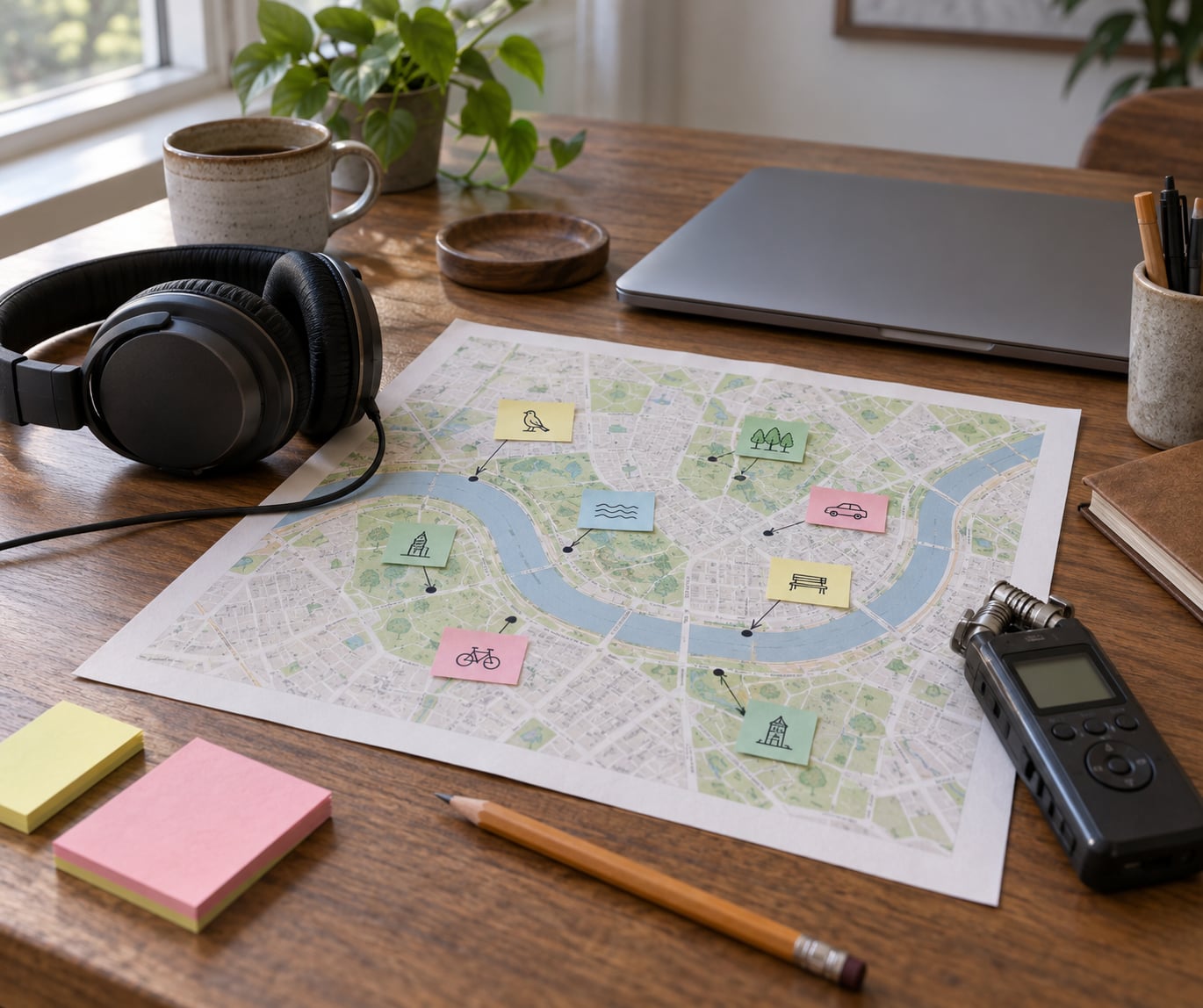
For each location, list the ambience that would be playing in that space and the three or four discrete sounds that could happen there. A hallway gets footsteps, a stairwell door, a neighbour’s television, a lift that does not arrive. Mark which beats get true silence, because silence is the loudest tool you have.
A script format and reference listening
Pick one convention for speaker names, sound cues and pauses, and stay with it. Then listen to three or four dramas in the same genre before you start. The Magnus Archives and Welcome to Night Vale built very different rules for the same medium, and knowing both styles keeps you from copying one by accident.
Step-by-Step: How to Write Audio Drama Crime Fiction
Here is the workflow I use. Seven stages, in order, and each one has a test that tells you whether it worked.
1. Define the audio-only promise
Decide what the listener must understand through voice and sound alone, and convert every piece of essential visual information into one of three channels: a line of dialogue, a narrated observation, or an object sound. A character looking at a file is fine. A character looking at a file is not, unless someone says what is on the page or a sound tells us the drawer opened and the paper was creased.
Test: read the scene aloud with your eyes shut. If you lose the thread, the problem is visual material that never made the conversion.
2. Start with a compact crime premise
Write down the central crime, the investigator or the victim, the pressure closing in, the suspicion the listener is meant to hold, and the question that will drive the story. Five lines on a page. This works because the dramatic question must force a listener to keep listening rather than let them admire the prose.
Test: say the question out loud. If the answer would not change who you suspect, you have a story, not a mystery.
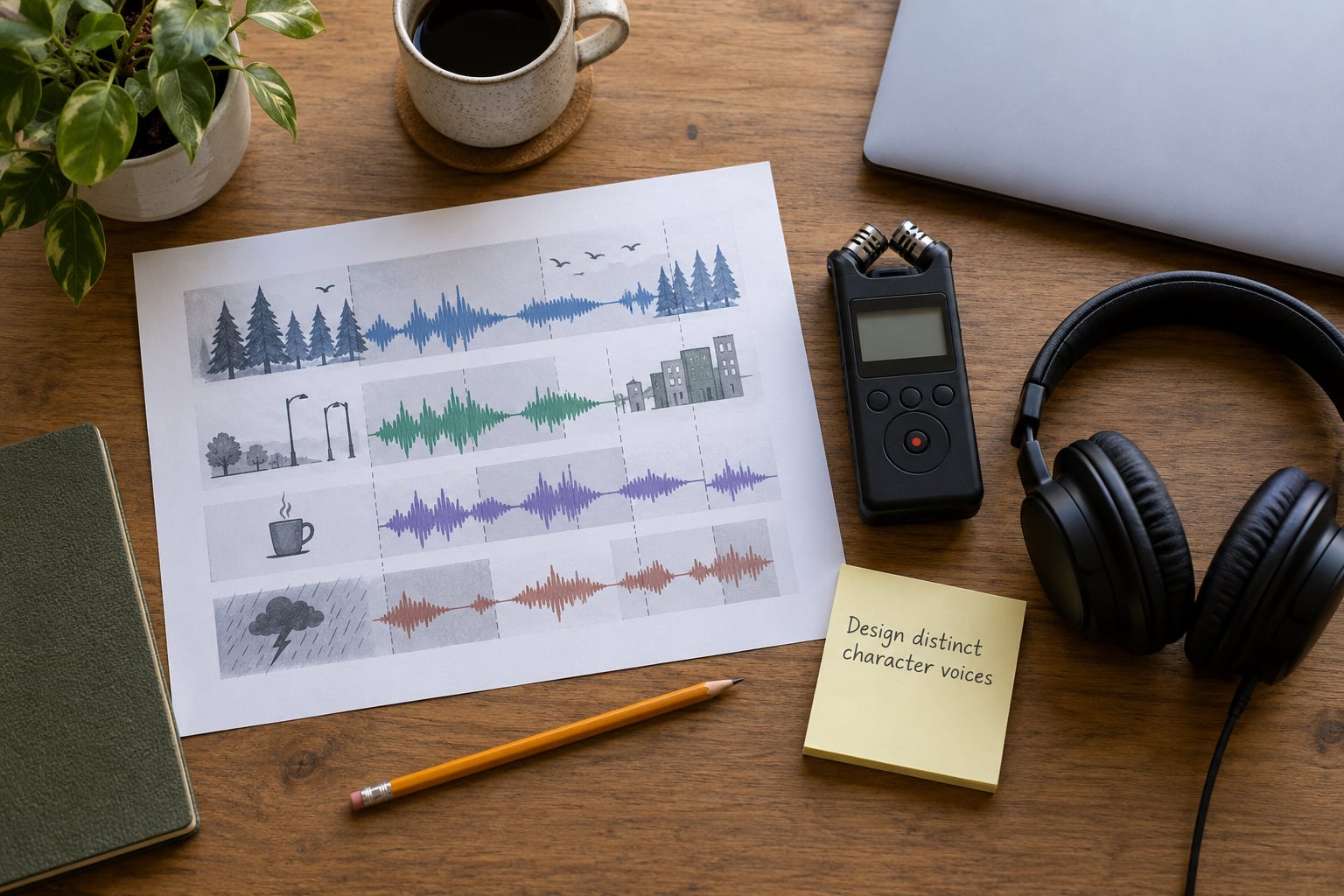
3. Design distinct character voices
Separate your characters with vocabulary, sentence length, dialect, social position, emotional control and listening habits — not with stereotypes. One detective interrupts herself. One barrister never finishes a sentence. One witness answers a question two beats after it was asked, which tells the detective she is choosing her words. Give each character one verbal tic that appears no more than twice an episode, or it becomes a gimmick.
Test: strip the names from ten random lines. Hand them to someone and ask who said each one. If they guess wrong, the voice is not finished.
4. Map sound and silence
For every scene, build a sound map with four columns: the ambience bed, the discrete effects, the transition cues, and the silences. Then give every single sound a job — it establishes place, it carries action, it shifts emotion, or it tightens tension. A sound that does none of those four is decoration, and decoration is exactly what makes scripts tiring to perform.
Test: read the sound column on its own. If the list does not tell you where you are, what just happened and how the character feels, add or cut.
5. Write audio-ready scenes
Orient the listener early, then stage action in the order it would actually be heard. Use narration sparingly and for movement between locations, not for summarising what the dialogue already carried. Name who speaks and who hears what as soon as a second voice enters, because a listener meeting two new speakers in the same breath has no faces to attach them to.
Test: the read-aloud test. Stand up, read the scene at performance pace, and mark every line where you had to reread. Those are the lines a stranger will miss.
6. Format the script for production
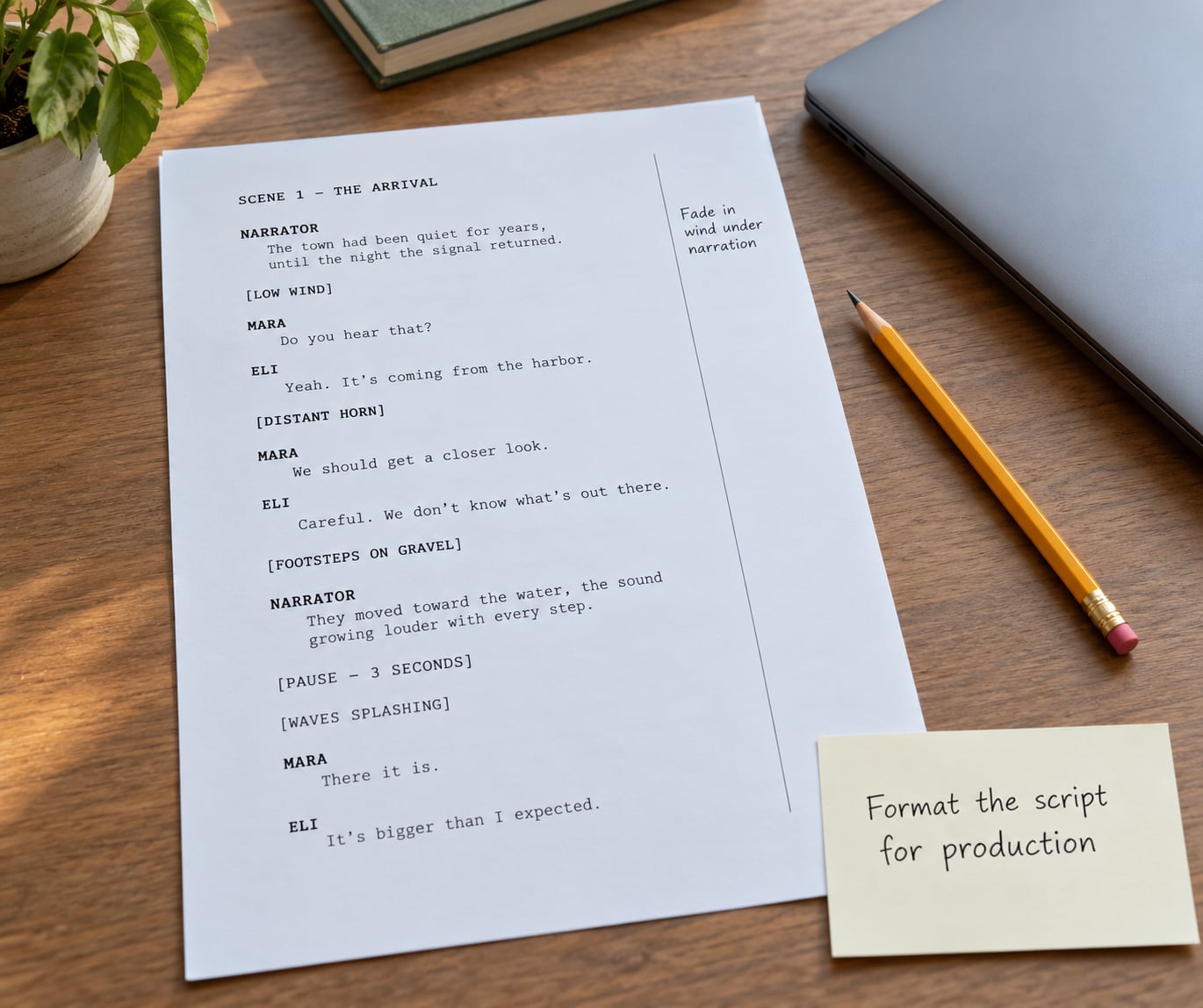
Use one consistent system for speakers, dialogue, narration, sound effects, ambience, pauses, music and production notes, and make the first and last lines of the episode unmistakable. Two widely used conventions: character names in capitals with direction in parentheses, sound effects written as bracketed cues such as [DOOR CLOSES — hallway], or the “FX:” prefix style where every non-dialogue line starts the same way. Pick the one your director already reads fastest.
A short annotated example, using the second style:
RACHEL: You said you were alone all night.
[AMBIENCE: rain on a window, a radiator ticking]
[PAUSE: three seconds]
VICTOR: I was. [BEAT] Ask my wife.
[STINGER: low string, single note, under the line]
RACHEL: (dry) She's been dead since March.
[AMBIENCE OUT]
Notice what the format is doing. The pause is scripted, so the performer and the mixer both know it counts. The stinger is placed under the line rather than after it. Rachel’s parenthetical is a tone direction an actor can act on. None of that information is in a novel, and none of it takes more than a few words.
Test: hand the script to someone who has never seen it and ask them to point to every sound cue. If they hesitate, the format is not doing its job.
7. Revise by listening
Read the whole thing aloud, at pace, more than once. Then revise for comprehension, pacing, voice differentiation, sound balance, repetition and the strength of the opening and closing lines. Kill any sound effect that fires twice in an episode with the same job, and cut dialogue where two characters explain something the third one already understands.
Test: the cold-listen test. Give the episode to someone who has not seen the case before and let them listen in a car or on a walk, where real listening happens. Ask one question afterwards: whose voice was that? If they cannot answer, the voices are still too close.
Common Mistakes
These are the failures I see most often in drafts from writers arriving from prose or screen, and each has a fix.
- Over-description. “She walks through the room, scanning the shelves” becomes “RACHEL: Nothing’s been moved. Not one thing. (she is still moving as she says it) [SHEET PAPER, folded]”. Fix: convert every visual verb into a sound, a line, or delete it.
- Interchangeable voices. Fix: cut dialogue and assign each character one habit — long sentences, interruptions, questions instead of answers, numbers instead of adjectives.
- Sound effects as decoration. A rain bed under every scene trains listeners to stop hearing cues. Fix: keep the ambience constant and let silence do the alarming.
- Unclear spatial relationships. Who is in the room changes everything in a crime scene. Fix: name the speaker and the listener in the direction, and mark physical movement with a sound.
- Unexplained speaker changes. Fix: pause, and identify the new voice in the first line, or use narration to cross a location change.
- Audio-direction overload. A page of parentheticals slows an actor to a crawl. Fix: keep direction to tone and physicality, never to motivation. Motivation lives in the words.
- Exposition dumps. The most mocked line in any writer’s room is “as you know.” Fix: cut the explanation and let a character find it out the hard way on the page.
- Forensics nobody can pronounce. Chemical names and Latin terms break the spell for a listener. Fix: keep the detail that matters to the case, drop the detail that is only impressive to write.
One habit worth adding: write a one-sentence logline and a rough ending before drafting, then let the middle find its own shape. Writers who fix both ends first find the story makes its own decisions, and the revision becomes tidying rather than rescue.
Frequently Asked Questions
How long should an audio drama crime scene be?
Most crime audio scenes run three to seven minutes, roughly 700 to 1,200 words of script, and a full episode usually holds five to eight scenes. Interrogation scenes should be shorter than you think, because tension comes from compression, not length. Give your cold listener three or four episodes before deciding a running time works for you.
Should a crime audio drama use narration, or only dialogue?
Use both, with a clear rule. Dialogue carries the case and the character conflict. Narration covers transitions, time jumps and the physical details a listener would otherwise miss. In noir and first-person crime fiction a narrating detective can carry the whole story, but keep their knowledge honest so the listener is never misled accidentally.
How do you make characters sound different without relying on accents?
Accents are the last resort, not the first. Separate voices by vocabulary, sentence rhythm, status, emotional control and listening habits. One character answers questions, one tells stories, one counts things aloud. Then check the test: strip the names from ten lines and see whether a listener can still sort them out.
When should music or sound effects be used in crime audio fiction?
Give every cue a narrative job before you add it. Use ambience to establish place and stay consistent with it, use a discrete effect for a specific action such as a lock or a stair, and reserve music for emotional shifts and act breaks. Silence before a reveal is usually stronger than a stinger, and listeners notice decoration long before they notice craft.
How do you show action and physical movement through sound alone?
Movement is easiest to convey through sound and consequence. Heavy footsteps mean a large person or a hurried one. A chair scraping means someone stood up too fast. A dropped glass ends the scene. You can also narrate the move in a single clause, but the goal is always to make the listener hear the action rather than be told about it.
What file format should I use when submitting an audio drama script?
Plain text, PDF or a word processor file are all safe, and PDF is the most portable for a submission. Keep your formatting plain and consistent rather than clever: capitals for speakers, parentheses for direction, brackets for sound effects, and a label for any margin note. Read the commissioning or competition guidelines once more before you attach the file.
Conclusion
Start with one short scene, roughly two minutes, and finish it. That single scene will teach you more about writing audio drama crime fiction than any article, because it will show you exactly which of your instincts came from the page. Then build the sound map and the character voice list before you polish a line of dialogue, and revise the whole script by listening out loud, checking comprehension, tension and sonic storytelling before you check grammar.