
A thriller logline is one sentence that names a specific person, the disaster that puts them in danger, what they must do about it, the force blocking them, and what is lost if they fail. Getting it right takes about an hour of drafting and three rounds of cutting, and the payoff is bigger than it sounds: a manager or agent usually decides whether to request your script from the logline alone.
Thriller loglines fail differently from other genres. A romance logline can survive vagueness because the appeal is the feeling. A thriller logline cannot, because the appeal is the mechanism. If the reader cannot picture what the hero is trying to do and what is trying to stop them, the pitch dies in the query letter.
What follows is the process I use, broken into seven steps, plus a comparison of the formats, worked before-and-after pairs, and a revision pass you can run on your own draft tonight.
Table of Contents
- What You Need
- How to Write a Logline for a Thriller, Step by Step
- Step 1: How to Write a Logline for a Thriller: Start With the Core Story
- Step 2: Center the Protagonist and Objective
- Step 3: Make the Stakes Immediate
- Step 4: Add Pressure and a Compelling Hook
- Step 5: Cut Setup, Backstory, and Generic Genre Language
- Step 6: Write for Sound and Brevity
- Step 7: Test and Present the Final Logline
- Common Mistakes
- Frequently Asked Questions
- How long should a thriller logline be?
- What is the difference between a thriller premise and a logline?
- Does a thriller logline always need a deadline?
- How much of the plot should a logline reveal?
- How do I fix a logline that sounds too spoilery?
- Start With the Collision, Not the Backstory
What You Need

You need six things before you write a word, and all six live in your head, not in a software package. Have a clear protagonist with a job or role that explains why they are near the danger. Have a central objective they can state in five words. Have one primary threat, not three. Have a sense of the core conflict as a collision rather than a mood. Have a reason the story matters to you beyond the mechanics. Have a scratch document and a timer.
The timer matters more than writers expect. Give yourself three minutes for a first attempt before you start editing. A logline drafted slowly becomes engineered, and an engineered logline reads like a manual. The rough version carries voice, and voice is what makes a sentence stick.
One quick clarification before you start, because writers constantly blur these formats:
| Format | Length | Job it does | Who reads it |
|---|---|---|---|
| Tagline | 2-7 words | Sells the title, not the story | Marketing, posters |
| Premise | One or two sentences | States the high concept without the plot | Any reader, including yourself |
| Logline | One sentence, 25-40 words | Compresses the whole dramatic engine | Agents, managers, contest readers |
| Synopsis | 1-3 pages | Walks through the story beat by beat | Executives after a request |
| Treatment | 5-30 pages | Prose version of the screenplay | Readers who already want it |
If you are unsure which one you are writing, that confusion is usually why your pitch feels wrong. A query letter wants a logline. A pitch meeting wants the premise in your mouth. A pitch deck wants the logline plus one line of tone and format.
How to Write a Logline for a Thriller, Step by Step
The finished sentence is one line, sometimes two. Two is fine when the second sentence carries information the first genuinely cannot. What is not fine is a second sentence that exists because you liked the phrase in it.
Step 1: How to Write a Logline for a Thriller: Start With the Core Story
Before you compress, expand. Write about 100 words: who the protagonist is, what has just gone wrong, what they want, what stands in the way, and what happens if they fail. Nothing polished. This is a private working paragraph, not something you will submit.
Then cut that paragraph down to its dramatic question. Almost every thriller premise reduces to a single sentence of the form: can this person do this thing before that happens?
Here is the difference a working paragraph makes. A vague premise reads: “A woman uncovers dangerous secrets about her past.” After the 100-word expansion and reduction, it becomes: “A hospice nurse who also delivers home visits finds her patient dead in a locked apartment, and the address on the file belongs to a house that burned down six years ago.” The second version has a person, an action, a rule being broken, and a mystery that generates pressure. Nobody has to guess what the movie is about.
Step 2: Center the Protagonist and Objective
Name who wants something specific, and name what prevents them from getting it. The test is simple: delete the protagonist from your pitch and see whether the story still exists. If it does, your lead is a camera, not a character.
Aim for objectives a reader can picture succeeding or failing. “Uncover the truth” is a mood. “Recover her stolen daughter before the blackmail photos are published at midnight” is an objective, because you can imagine the winning frame and the losing one.
Thriller protagonists usually carry a contradiction, and the contradiction belongs in the pitch. An investigator with a gambling debt, a surgeon who cannot stand blood, a translator hiding a language she claims not to speak. That pressure-bearing detail does more work than three sentences of backstory.
Step 3: Make the Stakes Immediate
Turn general consequences into what could happen next, and why that outcome matters to this particular person. “She could be in trouble” means nothing. “If she misses the 6 a.m. handover, her brother goes to federal custody” means everything.
You can layer stakes without inflating them: physical danger, emotional loss, professional ruin, and moral compromise can all appear in a single sentence if each one is true to your story. Pick two, not four. The instinct to stack four is what produces the melodramatic logline that sounds like a trailer and gets passed over.
Be honest about what your plot actually threatens. If the villain never gets close to the protagonist’s family, do not imply they do. A reader who is misled by your pitch resents it later, and in the query-letter world that resentment has a name and an address.
Step 4: Add Pressure and a Compelling Hook
A logline without an active force reads like a premise with the conflict removed. Name the thing doing the blocking, in a clause, not a biography. “A shadowy conspiracy” is a costume. “The only two people who know where the money is” is pressure.
Compressing an antagonist or a conspiracy is the hardest move in a thriller logline. You rarely need the organisation’s name. You need the mechanism it uses and the fact that it is aimed at your protagonist. The skill is describing the lever without describing the arm.
The thriller engine is usually one of three things: a closed setting nobody can leave, a ticking clock that will not be extended, or dramatic irony, where the audience knows something the protagonist does not. Any of the three can be a clause at the end of your sentence, and each one makes a logline read like a thriller rather than a story that happens to be tense.
Step 5: Cut Setup, Backstory, and Generic Genre Language
Most bloated thriller loglines fail the same way: they describe the world instead of the collision. Delete the character biography, the history of the town, the weather, the career history, and every secondary character who is not the threat.
Also delete generic genre language. “Dangerous secrets,” “a race against time,” “a heart-pounding journey,” “pulse-pounding thriller” tell a reader nothing, because every thriller on the market uses those words. Your plot has to do the work those adjectives were standing in for.
Take a bloated draft and keep only the details that either clarify the central collision or intensify its consequences. If a clause does neither, it goes. Do this in one pass, ruthlessly, and do not rebuild afterwards. Rebuilding is how writers end up back at the original length with better vocabulary.
Step 6: Write for Sound and Brevity
Read it out loud. If you run out of breath, cut. If you stumble, restructure. Loglines are spoken before they are read: at a table read, in a meeting, in an elevator, on a phone pitch.
Cut repeated nouns and repeated verbs, prefer strong active verbs over phrasal constructions, and vary the rhythm so the sentence has somewhere to land. Watch for the passive construction that hides the hero: “is forced to” should be “must,” and “is given the chance to” should go entirely.
Study real produced films as anchors. Se7en is usually described as two detectives hunting a killer who stages his murders around the seven deadly sins. Inception is a thief who steals corporate secrets by entering dreams. The Dark Knight is a masked vigilante holding a city together while a man with no plan beyond chaos pushes it apart. None of those sentences mention theme, and all of them are instantly filmable. That is the standard.
Keep the natural sound of your own voice while you edit for clarity. A logline that reads like a stranger wrote it will be submitted with the wrong energy attached to it.
Step 7: Test and Present the Final Logline
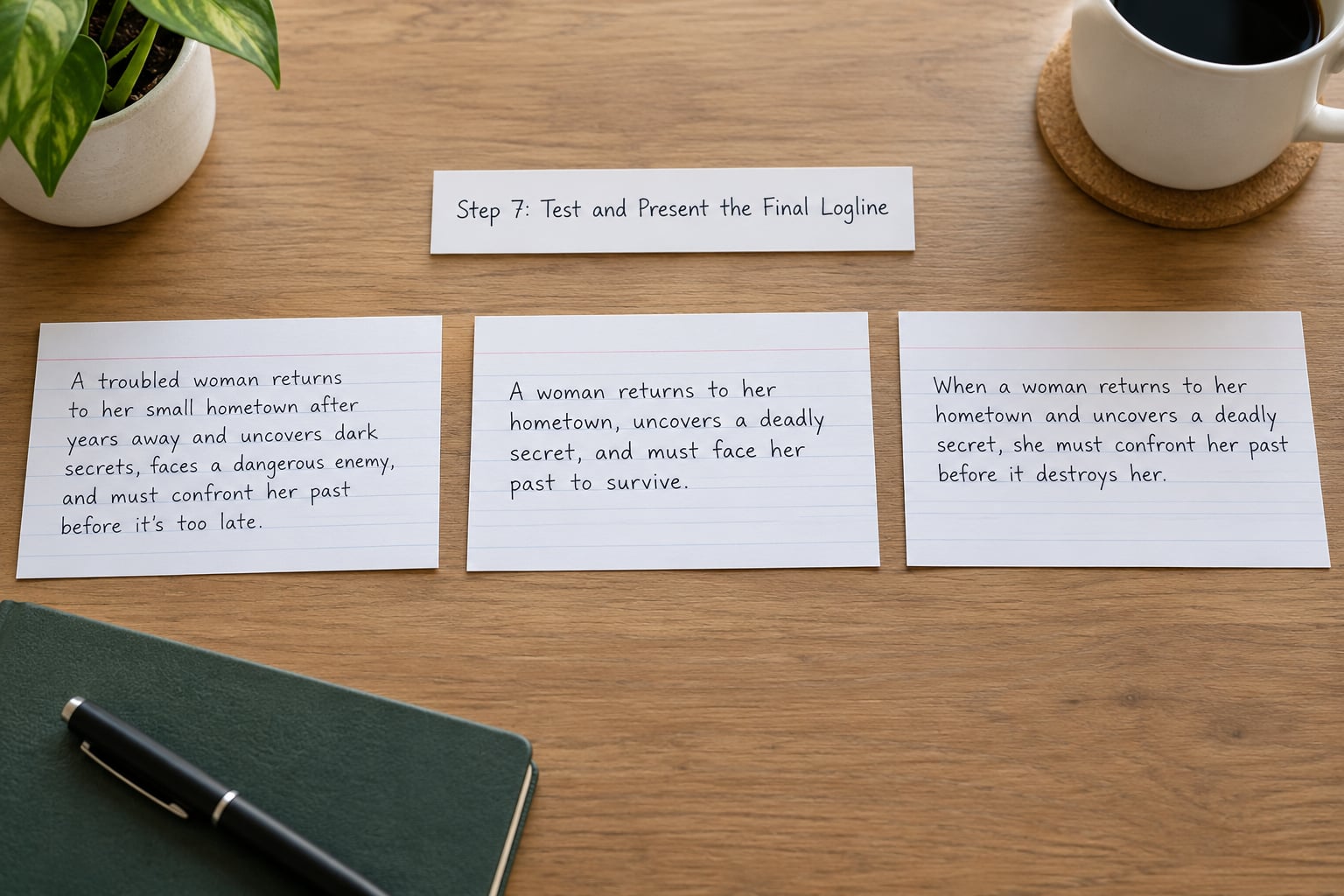
Run a checklist before anyone else sees it. Can you identify the protagonist without reading twice? Is the goal concrete? Is there one central obstacle rather than two unrelated ones? Are the stakes specific to this person? Is something applying pressure? Is there a reason to keep reading that is not “because it is good”? If any answer is no, that is your next edit.
Then write two versions. Keep a plain working version for yourself and for critique threads, because that is where you want the honest note. Write a polished query version that leads with the sharpest image and trims anything that reads as throat-clearing. The core idea does not change between them; only the packaging does.
Context does the same thing. In a pitch deck you can afford forty words because the reader is looking at your page. In a verbal pitch you need about fifteen, and you need the hook in the first five. Same story, different container, and the length moves with the container.
For feedback, writers on r/Screenwriting post loglines in a weekly critique thread where every submission states its genre and format, which is a good habit to copy for your own. Stage 32 runs logline feedback threads too. Be specific about what you want critiqued, because “is this good” gets you politeness instead of notes.
Common Mistakes
It is a plot summary. Symptom: you can feel beats arriving in order. Fix: cut every clause that describes an event in sequence rather than a collision in the moment. If removing it changes nothing about the reader’s appetite, it belongs in the synopsis.
The opening is passive or generic. Symptom: your sentence begins with “A woman,” “A man,” or “In a world where.” Fix: start on the verb or on the strangest concrete detail in your premise. The first six words should signal the genre, and they should do it before the reader has time to guess.
The stakes are interchangeable. Symptom: you could paste them onto a different thriller and the sentence would still work. Fix: stakes have to belong to your protagonist’s specific life. Personal consequence reads as pressure; universal consequence reads as decoration.
The backstory won. Symptom: the sentence spends most of its words on how the protagonist got there. Fix: backstory belongs in the synopsis, and usually not even there. If the backstory is essential, compress it to one clause at most.
The hook is misleading. Symptom: the pitch promises a chase and the script is a chamber piece about grief. Fix: write the sentence your script actually delivers. Buyers notice, and they remember.
There are two independent conflicts. Symptom: you cannot state the central obstacle in five words because you have two of them. Fix: pick one and let the other be discovered in the story. A logline that contains two movies contains neither.
It is trying to sound clever. Symptom: you love reading it aloud and you cannot say what the protagonist does. Fix: clarity wins every time. Any sentence that makes a reader admire the writing instead of picture the movie has failed at its job.
Three habits protect you from most of this. Keep the protagonist’s agency visible, so the sentence shows them doing something rather than having something happen to them. Test the hook aloud on someone who has not read a page of your script. And prepare distinct versions for readers with different jobs: the agent wants the engine, the studio executive wants the tone and the format, the contest reader wants to know whether you can write clean prose under a word limit.
Frequently Asked Questions
How long should a thriller logline be?
One sentence, usually 25 to 40 words, is the working target. A second sentence is acceptable when it carries information the first cannot hold, such as the ironic turn that makes the premise distinct. Resist a third sentence unless it earns its place by adding new stakes. If you are over 50 words, you are probably writing a synopsis, and trimming it later is harder than cutting now.
What is the difference between a thriller premise and a logline?
A premise states the high concept: the situation and the central idea, with little or no plot. A logline states the dramatic engine: a protagonist, an objective, an obstacle and stakes. Your premise might be about memory erasure. The logline built on that premise names who is hunting the erasures, who is erasing them, and what happens if they succeed.
Does a thriller logline always need a deadline?
No. A deadline is one of the strongest pressure devices you have, but pressure can also come from a closing door, an ally who betrays the protagonist, or a rule the protagonist has already broken. The requirement is not a clock; it is a force that prevents waiting. If your thriller runs on suspicion rather than time, say what makes waiting unbearable instead of inventing a countdown.
How much of the plot should a logline reveal?
Reveal the collision, not the outcome. Name the threat and what it threatens, but keep the mechanism that produces the twist unstated. A logline that states the ending removes the reason to read the script. Writers who worry they are being too vague usually need to be more concrete about the danger, not more explicit about the resolution.
How do I fix a logline that sounds too spoilery?
Replace the resolution with the question that generates it. Instead of stating what the twist is, describe the impossible situation that makes the twist necessary. Saying the killer turns out to be someone close collapses the read; saying the protagonist must solve the case without telling anyone they trust creates forty more problems across a hundred pages. Promise pressure, not answers.
Start With the Collision, Not the Backstory
Write one sentence tonight: a named person, a specific thing they must do, one force stopping them, and what is lost if they fail. Read it aloud, cut anything that does not clarify or intensify, and write the trimmed version on a fresh index card. That card is your logline, and knowing how to write a logline for a thriller becomes obvious once you can say your story in a breath.