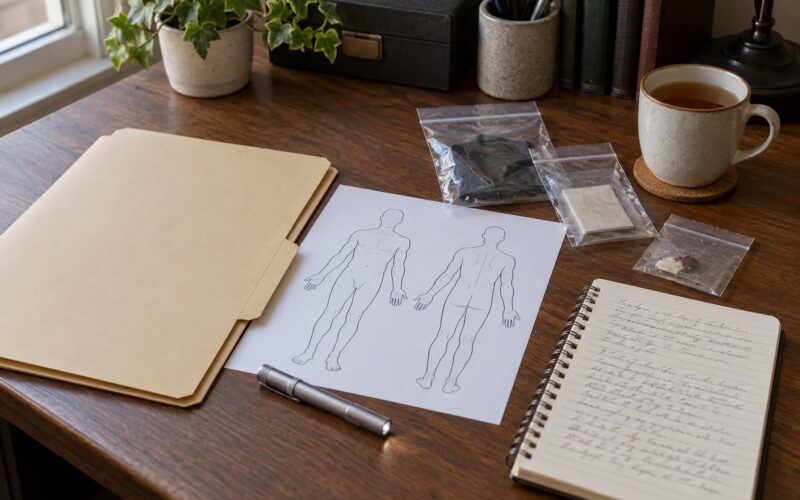
Chain of custody becomes plot the moment you treat a documented handoff as a thing a character wanted. The technique is simple: choose one piece of evidence, draw the honest line of everyone who touched it, and leave one gap in that line. Every later scene then asks the same question, and the detective has to answer it with a suspect, a motive and a confrontation.
That is the whole craft of it. The procedure is the plot engine, and the writing challenge is keeping the procedure out of the reader’s way.
What is chain of custody in a story? Chain of custody (also called the chain of evidence) is the unbroken written record of who handled a piece of physical or digital evidence, when they handled it, and what they did to it. In fiction, that record is not paperwork filler. It is a timeline of opportunity, and any hole in it identifies who could have planted, altered or removed the item.
The two stories in a mystery are the crime and the solving of it. The custody record is the wire between them, and it is the one element most writers leave to a single line of dialogue near the end.
Table of Contents
- What You Need to Write Chain of Custody Into a Plot
- Step-by-Step: The Seven Steps That Build the Plot
- 1. Decide What the Evidence Must Prove
- 2. Map Every Legitimate Transfer
- 3. Create a Credible Point of Failure
- 4. Build the Chain of Custody Into the Plot
- 5. Let the Procedure Create Character Pressure
- 6. Plant and Pay Off Specific Details
- 7. Test the Plot for Legal and Narrative Logic
- Common Mistakes and How to Fix Each One
- Frequently Asked Questions
- How much chain-of-custody detail should a crime novel include?
- Can chain of custody work as a metaphor or subtext?
- What is the difference between contaminated evidence and a broken chain?
- Should the reader know who compromised the evidence before the detective does?
- How can chain of custody create suspense without slowing the plot?
- Do writers need forensic or legal sources to make the sequence believable?
- Conclusion: Start With One Item, One Gap, One Consequence
What You Need to Write Chain of Custody Into a Plot
You need five things before you write a single scene, and none of them require a research degree.
One specific item. Not “a weapon” but a particular thing with a serial number, a size, a distinguishing mark and a normal home. Props with identity are easier to track and easier to lose.
A handler roster. List every person who will legitimately touch the item, in order. Real departments run somewhere between four and eight people through a single piece of physical evidence: the officer who collects it, a second who witnesses or seals it, the property room technician, the technician who pulls it for the lab, the analyst, the person who returns it, and whoever carries it to court.
One break. A single documented failure, not a pile of them. Two breaks in the same story cancel each other out, because the reader stops believing either.
A consequence. Decide now what the break costs: a suppressed suspect, a thrown-out exhibit, a destroyed career, a body that stays buried. A break with no consequence is a continuity slip, not a plot.
A story question. Write it as a sentence with a person in it. “Who opened the bag?” is weak. “Who had eleven minutes alone in the property room on the night of the fourteenth, and why did nobody log it?” is a question with a shape you can build scenes around.
You also need somewhere to keep the real version. A spreadsheet, a notebook, a single doc, whatever you already open every morning. Writers on WritingForums describe the same bookkeeping fatigue in mystery drafting, and the usual answer is a plain spreadsheet with no schema given. The columns below are that schema, and I have used the same six-column shape for every chain of custody in fiction.
On accuracy, take the position veteran writers take on the WritingForums thread “Bad Science In Good Fiction”: fiction has to bend the truth, and the line gets crossed when the author sells the bend as fact. If the procedure is load-bearing in your plot, get it right. If it is scenery, bend it freely and say nothing.
Step-by-Step: The Seven Steps That Build the Plot
Work through these in order. Each one produces a concrete story outcome, so you can stop as soon as you have the outcome you need.
1. Decide What the Evidence Must Prove
Write one sentence stating the single proposition the item supports: the time of death was after ten, the wound came from a left-handed person, the file was opened after the arrest. One item, one proposition.
The common failure is the clue that proves everything. A torn glove fragment with blood, soil and a hair in it feels meaty, and it quietly solves motive, method and identity at once, which leaves the detective nothing to do for two hundred pages.
Split it instead. The glove fragment supports “handled by someone at the scene.” The soil supports “came from the north embankment.” The hair supports “not the victim’s.” Three items, three propositions, three different people who can be asked about each one. You have just built a cast out of evidence, which is far more durable than a single object that answers everything.
2. Map Every Legitimate Transfer
Run the item through its full life and write down every transfer as it would be recorded: who had it, when they took it, when they signed it over, to whom, and whether the seal was intact at each handoff.
The stages most writers skip are the boring ones, and the boring ones are where plots live.
- Discovery and scene log. Found by whom, at what time, in whose presence. A scene log that lists four people entering in the wrong order is a free, fair-play clue that you can pay off in chapter nineteen.
- Documentation. Description, case number, date and time stamp. The description matters most: “one black sock, right foot, torn at the heel” survives storage. “A sock” does not, and a lazy description that later turns out to be a lie is one of the strongest breaks you can build.
- Packaging and sealing. Tamper-evident sealing, distinct from a plain sealed bag. The seal exists to show nobody opened it, which means a seal that has been opened and resealed is a different object with a different history, and the difference is invisible to everyone who does not know to look.
- Storage. The property room or evidence room, with access logged or unlogged depending on your setting. This is the most common break in real investigations and the most useful one in fiction.
- Lab intake and accessioning. The item gets an accession number, which is a new name for the same object. Renaming is a gift to you: two records with two numbers and one item is a classic contradiction.
- Examination. Destructive testing consumes part of the item. A swab taken means the original is smaller than it was, and any later claim that the original was intact becomes a question.
- Disclosure and court. Shown to the defence, entered as an exhibit. This is where admissibility stops being a technical worry and becomes a scene with a person sweating in it.
Then put the whole line into a ledger you can keep open next to your draft. Copy this structure into your own tool and fill the columns as the plot develops.
| Item | Description as written | Collected by / when | Transferred to / when | Seal intact? | Gap |
|---|---|---|---|---|---|
| Item 1 | Black wool scarf, one end burned | Detective Ruiz, 23:40 | Evidence tech Okafor, 00:15 | Yes | None |
| Item 1 | Same, re-labelled as recovered from stairwell | Not recorded | Property room, unknown time | Seal replaced | Unknown handler |
| Item 2 | Paper receipt, damp, partially legible | Officer Bell, 23:52 | Lab intake, 09:10 | No | Night shift unaccounted |
| Item 3 | Recovered phone, screen intact | Detective Ruiz, 23:58 | Digital forensics, 08:00 | Yes | None |
| Item 4 | Deed copy, no seal, unsigned | Witness interview, next day | Case file, no transfer | n/a | Provenance is a story told aloud |
| Item 5 | Blank field | Blank field | Blank field | Blank field | Blank field |
Read that last row as your template, not as filler. A blank row is an unused evidence slot, and it reminds you the story is not yet finished.
3. Create a Credible Point of Failure
Pick one failure that a real department could plausibly produce, then attach it to a person and a reason.
| Break type | How it happens | What it does to the plot |
|---|---|---|
| Accident | Evidence left in an unlocked office overnight | Establishes the danger before anyone commits a crime. The break is the reason the theft is possible. |
| Laziness | One signature skipped to save ten minutes at shift change | Produces a small, guilty, believable culprit who did not intend harm. Great for exposing a cover-up rather than starting one. |
| Planted error | A description deliberately written wrong at collection | Turns a document into a confession. Requires a character who wants the record to lie, which is motive enough on its own. |
| Forgery | Backdated or invented transfer entries | Sets up a courtroom fight over admissibility and puts a colleague under suspicion. |
| Substitution | One item swapped for a lookalike between storage and court | Highest stakes, hardest to pull off. Requires the detective to notice a detail that is technically correct and completely wrong. |
| Theft | The item removed from the property room to suppress it | Creates a second crime, gives the antagonist a clock, and explains why someone was willing to kill to keep it quiet. |
Two of these are worth building motive around directly. A planted error and a suppression theft both answer the question every plot needs: why was this person willing to take a risk that could end their career? Nobody tampers with a record for fun, and if you cannot answer that question, your break will read as author convenience.
One useful check on motive: a break should be something the person could not undo. A missing signature is a lie, but a replaced seal is a permanent state that someone else can examine later.
4. Build the Chain of Custody Into the Plot
Now make the record do work. A custody line that exists only to be read aloud in a courtroom scene is a speech. A custody line that changes what people do is a plot.
It narrows suspects. If the lab required two signatures to release the item and the log shows one, the pool of people who could have removed it is now the people whose signature is missing. That is a fair-play clue, a motive, and a confrontation, all from one line in a form.
It exposes a lie. A witness who insists an item was locked away can be broken gently, by someone reading a time stamp back to them. Do not have the detective shout. Have them ask the witness to look at the clock on the wall and then look at the form again.
It redirects the investigation. The gap might send the case toward a family member, a business partner, or the department itself, and each of those turns is a fresh chapter move rather than another interview with the same suspect.
Now decide who knows what, and when. This is the distinction that separates a working plot from a confusing one: author truth is the chain as it actually happened, which only you know, and reader truth is the chain the reader can reconstruct from what you put on the page. Both need to be available to you, and the reader’s version must be fair. If your reveal depends on a signature nobody mentioned, you have not written a fair-play mystery, you have written a gotcha.
Thread one item across five chapters to see the shape. In chapter one, a burned scarf is bagged and sealed with the description written out loud. In chapter two, the description appears in a report with one word changed, and the detective notes it without commenting. In chapter three, the scene log shows a person who claims never to have been in the building. In chapter four, the seal is found replaced, and the reader can now date the interference. In chapter five, the confrontation happens over a form nobody thought to read twice.
Every one of those beats is documented somewhere on the page, and none of them is explained to the reader as a clue. That is what keeps it out of filler territory.
Digital evidence works the same way with different nouns, and no current crime-fiction guide covers it. A file or a phone is copied rather than moved, and the chain is tracked with a hash value that changes if the copy changes. The break is not a torn seal but an access log with a missing entry, a device that was never switched off, or a retention window that quietly deleted the video your witness depends on. Give the digital version the same three questions as the physical one: who had access, when, and who benefits from the uncertainty.
5. Let the Procedure Create Character Pressure
The paperwork is a character test. Everyone wants the evidence to speak quickly, and the process refuses to hurry, so the pressure lands on people instead of on the plot.
Put it on a detective who is proud of being clean. She signs, dates, logs and never cuts a corner, and that pride is what makes her suspect when the exhibit falls apart. Put it on a partner who calls the form a bureaucratic ritual and skips a line once, in a scene played for nothing, so the reader can see the exact moment the case becomes fragile. Put it on a supervisor whose job depends on the case holding up and who therefore has a real reason to want one gap to stay unexamined.
The strained relationship is the most efficient version. A detective who trusts a lab analyst and a detective who does not will read the same custody form as either reassurance or evidence of tampering, and the argument between them is a scene that costs you no exposition at all.
Procedural friction also solves the sagging middle. When a chapter is just an investigation, it reads as a list. When a chapter is a specific person blocked by a specific form, it reads as pressure, and the reader feels the time passing while nothing dramatic is happening on the surface.
6. Plant and Pay Off Specific Details
Plant concrete, checkable details at the stage where they are first plausible, and pay each one off later.
The rule worth memorizing is the two-signatures rule. Have a character mention, early and casually, that the lab needs two signatures before it will release an item. Do not underline it. Six chapters later, one signature is missing, the pool of suspects contracts to three people, and the reader can go back and find the moment. That is foreshadowing doing work instead of decorating.
The same applies to a seal number spoken aloud, a time stamp nobody bothers to check, a storage room key that belongs to three people, or a description written in a hurry. Each of these is a plant, and each needs a payoff that follows from the detail itself rather than from a new fact introduced at the reveal.
Pay off by consequence, not by exposition. The strongest version of a payoff is a character acting differently because of what the reader now understands, and the weakest is a forensic scientist explaining in a lecture what the seal number meant.
Keep a plant list beside the draft, with three columns: where it was planted, what it will mean later, and the chapter where it pays off. This is the same discipline as a clue ledger, and it catches the plants you forgot you made.
7. Test the Plot for Legal and Narrative Logic
Run four checks before you call the outline finished.
Is the sequence physically possible? Walk the timeline on a single sheet of paper with real clock times. Can any handler be where the record says they were? Can the item be in two places at once? A contradiction here reads to readers as author error, not as mystery.
Does every handler have a reason to touch the item? If a character with no official role appears in the chain, that is either a plot point you have not written yet or a break you have not decided on. Fix it deliberately.
Does the outcome follow from the planted information? Read only the evidence you gave the reader, not the outline in your head. If the detective’s conclusion cannot be reached from the page, add the missing plant or change the conclusion.
Have you checked your procedure against two sources? Agency guidance and a working professional disagree often enough that one source is not enough. If the detail is load-bearing, an interview is worth more than a week of reading. Janet Laurence’s warning in Writing Crime Fiction: Making Crime Pay is the right instinct here: do not let research stop you from starting the actual writing. Get the specific procedure right, invent the rest.
That four-point pass takes an hour and catches nearly everything a knowledgeable reader would.
Common Mistakes and How to Fix Each One
Overexplaining the procedure. If two consecutive paragraphs contain the word custody, you are lecturing. Cut the second one and keep the scene. Readers want to know that a signature was skipped, not what the signature system is modelled on.
Contamination that happens to suit you. If a swab only gets taken after the detective needed the result, the plot has bent the science rather than the reader’s patience. Move the collection earlier and make the delay the problem.
Interchangeable evidence labels. Five items all described as “a bag of items” is bookkeeping laziness that will surface in chapter twenty. Give every item one distinguishing feature and use it consistently. If you cannot remember which label belonged to which object, neither can your reader, and the confusion will read as unfairness.
Unexplained access. A break only works if the reader can see it was possible. Name the unlocked door, the shared key, the three-person storage shelf, the night shift with no log. A gap nobody could have exploited is not a clue.
Instant results. Real analysis takes time, and time is free suspense. Send the item to the lab in chapter six and let your protagonist chase something else while it works. The waiting is the plot.
A break with no motive. Ask why the person would risk everything for this item, and make the answer about the item, not about the plot. A break committed for a reason the reader accepts will carry a whole third act.
Treating the record as proof of guilt. A custody gap proves opportunity and bad procedure, not guilt. The moment your detective treats paperwork as a verdict, the story stops being fair-play and starts being a plot convenience. The gap narrows the pool; the confrontation still has to do the rest.
Introducing a new item at the reveal. A piece of evidence that has never been on the page cannot be a payoff. Add it in an early chapter as something nobody looked at properly.
Frequently Asked Questions
How much chain-of-custody detail should a crime novel include?
Enough for the reader to follow one item through one gap. Most readers will hold a rule for about four lines, so give them the collection, one transfer, the break and the consequence, and let everything else stay in dialogue. A couple of concrete nouns, a tamper-evident seal and a property room, do more work than a paragraph explaining the system. Accuracy earns trust only where the detail is load-bearing.
Can chain of custody work as a metaphor or subtext?
Yes, and it is at its best as subtext rather than symbol. A record that should be continuous and is not maps neatly onto a marriage, a friendship, a departmental culture or a country’s official story. Keep the literal chain doing the plot work so the reader can anchor the metaphor, and let the thematic reading arrive without being announced. Announced metaphors read as morals.
What is the difference between contaminated evidence and a broken chain?
Contamination changes the item itself: a stray fibre, a poor seal, an unclean surface, a sample handled too many times. A broken chain changes the record of the item: every transfer was documented properly, but something is missing from the paperwork, or the history cannot be reconstructed. Contamination weakens what the item proves. A broken chain weakens whether anyone can prove what the item shows, which is a different problem and often a better one for a plot.
Should the reader know who compromised the evidence before the detective does?
Either works, and each buys you something different. If the reader knows first, the suspense moves from what happened to whether the detective will notice, and you can create dread by having them watch her trust the wrong person. If the detective knows first, the reader is ahead on the facts and behind on the meaning, which builds sympathy instead. What does not work is hiding a fact that is impossible to withhold, because a reader who spots an unexplained inconsistency stops trusting the whole book.
How can chain of custody create suspense without slowing the plot?
Attach the procedure to a person and a clock rather than to a form. A missing signature matters far more once the reader knows that a hearing is in three days or that one analyst’s career depends on the exhibit holding. Turn the tracking work into an active scene: someone chasing a signature, calling a property room at closing time, waiting on an accession number. The search supplies the tension, and the paperwork stays off the page.
Do writers need forensic or legal sources to make the sequence believable?
You need sources for the steps your plot turns on, and none for the rest. Agency guidance, professional association material and interviews with working staff cover the handling and documentation sequence well enough for fiction. Check any single claim against a second source, since reputable agencies disagree on procedure. Where you are knowingly wrong, keep it small, keep it out of the load-bearing moments, and never have a character present an invention as a rule.
Conclusion: Start With One Item, One Gap, One Consequence
The method reduces to four moves. Give your evidence one proposition to prove. Run it through a full, believable line of handlers. Put a single documented break inside that line and give the person who made it a reason. Then let the record change what people do, and let the change cost something.
Start your next session with the ledger rather than the prose. Fill in one row for the item you already know your story needs, write the six columns, and see where the honest line of handlers puts you. The gap usually appears on its own, in the column you filled in fastest.
Once it is there, decide who the reader learns about it from, and on what page. Everything after that is scenes.