To write a crime scene technician who survives contact with a knowledgeable reader, you have to build them from the ground up: what the job actually allows them to touch, say and conclude, then what they want badly enough to keep going. The eight steps below move from research, through procedure and character, to the edit pass that keeps the technical detail serving the story. Budget a solid week for a first draft of a single technician, and expect several passes of fact-checking after that.
The job is narrower than television makes it look. A crime scene technician identifies, documents, collects and preserves physical evidence. They work under a detective’s direction, not around it, and they hand material to a laboratory rather than solving anything themselves on the spot.
That gap between what a technician does and what a fictional genius does is exactly where good crime fiction lives. Here is how I build one.
Table of Contents
- What You Need
- The type of scene
- A plausible US jurisdiction
- The limits of the evidence
- The job’s place in the timeline
- The technician’s own motive
- How to Write a Crime Scene Technician: Step-by-Step
- How to Write a Crime Scene Technician’s Role
- Choose the Right Case and Jurisdiction
- Build a Believable Working Method
- Make the Technician a Character, Not a Cameo
- Use Evidence to Create Conflict
- Write Dialogue That Sounds Like the Work
- Show the Limits and Consequences
- Edit for Technical and Story Credibility
- Common Mistakes
- Frequently Asked Questions
- Do I need a forensic science degree to write a crime scene technician?
- What can a crime scene technician realistically identify at the scene?
- How much procedural research should I do for a crime novel?
- How do I write technical crime scene dialogue without sounding unrealistic?
- Can a crime scene technician identify the killer or solve the case?
- How do I keep forensic details from taking over my mystery plot?
- Conclusion
What You Need
Before you draft a single line of dialogue, five things need to be settled. Skip them and your technician will sound like a Wikipedia entry with a badge number.
The type of scene
A burglary, a overdose in a motel room and a mass shooting demand completely different technicians. One may be a generalist working a room for two hours. Another brings a team, a supervisor, a medical examiner, a representative from the coroner’s office and a rotating shift schedule. Decide which your story needs, because the scene determines everything downstream.
A plausible US jurisdiction
Title requirements, certification standards, who has search warrant authority and how property is stored all vary by state and by agency. Pick a real state and check that state’s certification body. You do not need to memorise the code, but you should know which rules your character follows and be able to name them.
The limits of the evidence
Decide what your scene realistically yields, and what it does not. Fingerprints on a clean surface are not a promise. Absence of a trace means nothing on its own. A stain may be blood, may not be, and nobody in the field settles that. Writing the limit down early prevents the convenient-evidence problem later.
The job’s place in the timeline
Note when the technician arrives relative to the call, and what has already happened. The body is out of the way before the work starts in most cases. Time of death is a range built from body temperature, lividity, decomposition and the stomach contents, refined against scene temperature and clothing. It is never a single minute on the clock.
The technician’s own motive
Occupation is not motivation. Decide what this person is doing at this job right now. Paying off a sibling’s house, working a county that gave them a scholarship they resent, counting days until a transfer. The answer decides what they notice, what they rush and what they refuse to write down.
How to Write a Crime Scene Technician: Step-by-Step
How to Write a Crime Scene Technician’s Role
Start by drawing the boundary between four jobs that fiction constantly blends: the detective, the crime scene investigator, the technician and the laboratory analyst.
The detective directs the investigation, develops information, interviews people and builds the case. The crime scene investigator is often a detective or detective-grade role that both investigates and processes scenes, and the title varies wildly by department. The technician, often called a crime scene specialist, civilian crime scene investigator or evidence technician, is the person whose whole job is the physical scene. The laboratory analyst works behind the bench, running the tests, and their results arrive days or weeks later, not on cue.
Write down what your technician does and does not do. They document, they collect, they package, they log, they hand off. They do not interrogate the neighbour, they do not build a profile, and they do not walk into a lab and read a result in an hour. When a scene needs a suspect, your technician hands the detective a fact and the detective turns it into a person.
One useful test: if removing the technician would leave the plot intact, the character is set dressing. If removing them collapses the case, you know which scenes they own.
Choose the Right Case and Jurisdiction
Match the crime to the tone you are actually writing. A literary novel about grief wants a quiet scene with one body, one witness who saw nothing, and a technician who has been through too many of them. A procedural wants volume, shift work and the ordinary ugliness of a room nobody wants to enter.
Then anchor it. Pick the state, and check what its certification board actually requires. Most technicians hold at least a general science or criminal justice degree, complete a documented on-the-job training programme under a qualified technician, sit a written and practical exam, and maintain continuing education and periodic proficiency testing. Some states and larger agencies add bloodstain pattern analysis or advanced scene photography to the base credential.
That credential is a plot device. A technician who is board-certified can be crossed by a defence attorney on the ground that their method is not generally accepted. A technician without it can be attacked on cross-examination for going beyond their training. Either way, the certification is a source of pressure, not a badge of competence.
Make the jurisdiction visible through detail rather than exposition. Weather, response times, who dispatch sends, whether a rural department has its own processing unit or sends evidence to a regional lab. Small details read as knowledge and cost you nothing.
Build a Believable Working Method
Procedure is where most crime novels get caught. Work through the sequence and only keep the parts that create pressure.
Preparation and arrival. Before entering, they are briefed on the type of call, the hazards, and who else is on scene. They arrive in personal protective equipment and a clean change of gloves, because everything they carry in is contamination they have to manage for the next several hours.
Scene control. A real scene is tightly secured. Only assigned personnel cross a threshold, and the paths people take through a scene are recorded because those paths are where evidence gets added or destroyed. Technicians frequently work a single narrow path, disturbing as little as possible.
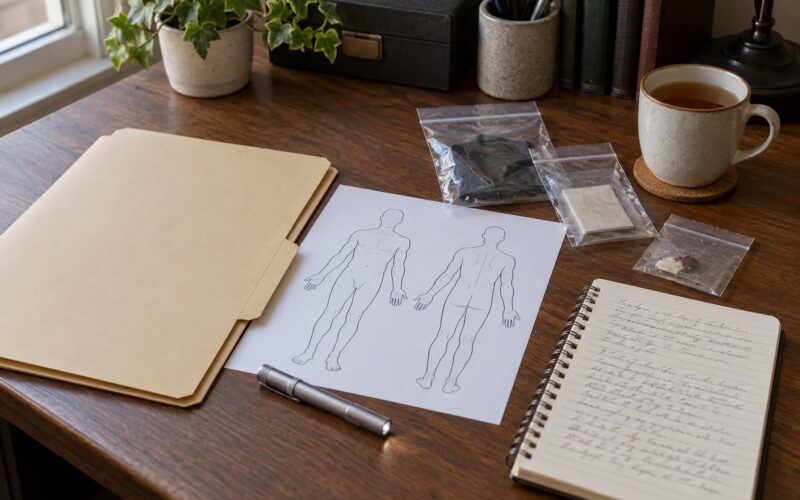
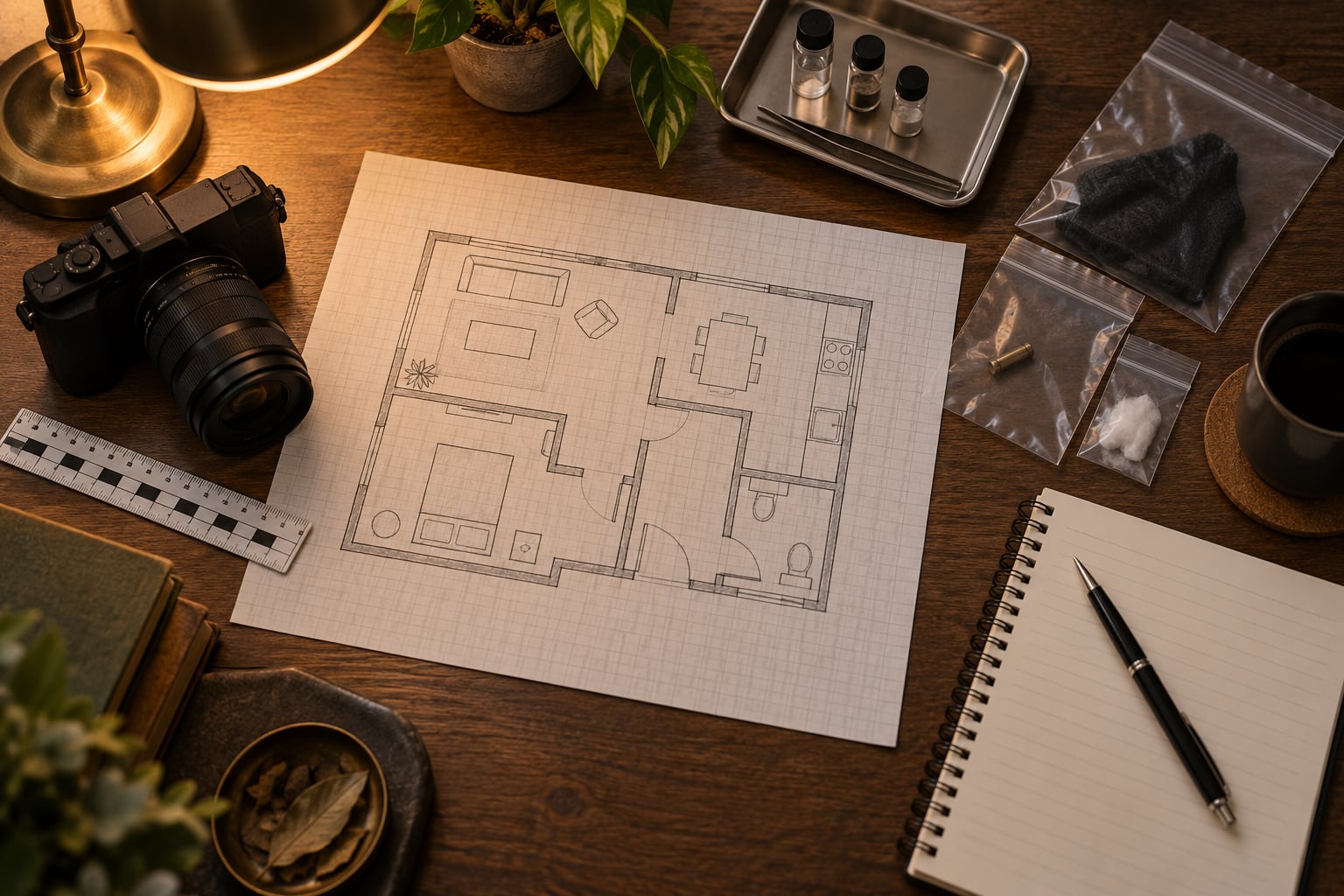
Documentation before collection. Photographs first, wide then mid-range then close, usually with a scale and a case number card in frame. A sketch or diagram follows, giving spatial relationships that photographs flatten. Notes run alongside both, and the whole package is the reason a search can be defended later.
Collection and packaging. Each item is handled with the least destructive method available, sealed in its own container, labelled with a unique item number, date, time and collector, then logged. That log is chain of custody, and it is a documented trail of who touched what and when.
Handoff and the report. The report is written the same day or the next, and it is the document a courtroom sees. Its tone is flat and procedural: what was found, where, how it was collected, what was not collected and why.
Do not narrate all of that. Choose two or three steps per scene, and let the others happen offstage. The unremarkable step you skip is not a missed opportunity, it is pacing.
For a fiction excerpt, a short report line reads well in fiction: item 14, one clear glass tumbler, kitchen counter, approx. 120 ml of liquid, sealed and submitted to the county laboratory for analysis. It tells the reader the technician is competent and moves the plot by one inch, which is exactly the right size.
Make the Technician a Character, Not a Cameo
Give them a private skill, a professional frustration, a position on a hard question, and a habit that shows up under stress. Then connect those to choices.
The private skill is something they are good at that nobody praises. They can read a room for the spot where a lie was told, or they are unusually patient with a task nobody else wants, or they can reconstruct how someone walked through a space by looking at a floor. The frustration is structural: understaffed, called out constantly, second-shift when the calls cluster at night, or a department that treats them as facility services until a case goes wrong. The ethical question is the engine. Do they report a procedural violation by a partner? Do they flag a piece of evidence that weakens the case they would like to see win? Do they stay silent because the suspect deserves to be caught more than because the rule is right?
Habits do the work that adjectives cannot. Wiping a glove seam before touching anything. Answering a question with a specification instead of an opinion. Stepping back from the body a half-beat earlier than a civilian would.
Put the character in a relationship too. A new partner who resents the paperwork, an investigator they used to work with, a supervisor who trained them and now signs off on their reports. Then let that relationship produce a real decision, not just banter.
One more thing: give them a reaction to the death itself. Technicians see bodies constantly and this is not depicted nearly enough. It usually does not show as a breakdown. It shows as a longer pause before the next call, a skipped lunch, or a decision to go back and re-photograph something nobody asked them to re-photograph.
Use Evidence to Create Conflict
Evidence is at its most useful as a source of friction, not answers. A technician who can explain why a finding is ambiguous is far more interesting than one who delivers it.
Build tension from the ordinary problems. Contamination risk, because anything the technician touches can be challenged later. Ambiguity, because a partial print may be too smudged to compare, and a surface that shows no trace may have been cleaned or may never have held anything. Competing interpretations, because the same stain can support two stories and only the laboratory will say which one holds. Repeat visits, because a scene may be released and then re-examined once new information arrives, and by then it is a different room full of people.
Time is the best pressure you have. Documentation takes hours. A supervisor wants a preliminary finding. A detective needs to release the scene. The technician needs another hour for the lighting, and the hour costs them the ability to tell the detective what they all want to hear.
Then let the character be right about the process and still wrong about the case. A technician can correctly state that a substance is not blood and still be unable to explain the wound. That gap is a scene.
Write Dialogue That Sounds Like the Work
Professionals in the same room talk in short, specific exchanges. They interrupt. They correct terms. They say what they need and what they cannot promise.
Watch the vocabulary. Technicians are precise about categories: cause of death, manner of death, a body recovered in a particular condition. They do not say cause and manner interchangeably. If your character uses a term loosely, have someone else correct them on the page rather than in a glossary.
Keep jargon to the words a person in that room would actually use. Explain a term once, through action, and then trust the reader. A character who says a laboratory will take weeks to return a result needs to say it once, plainly. Everyone repeating the same technical noun in every scene is not realism, it is a lecture.
Let the technician ask questions. They need to know whether the room was moved, whether anyone walked through, whether the deceased lived here, whether anything has been moved since this morning. Those questions are characterisation too, because who a person interrogates reveals what they are hunting.
And let them say no. The most human line a technician can give a detective is a version of I cannot tell you that from here, and it can carry a whole scene on its own.
Show the Limits and Consequences
A technician cannot instantly solve a crime, restore a trace that was never collected, identify a substance at the scene, or skip legal safeguards. Once a scene is released, ordinary life and weather move through it. Once evidence is sealed badly, its value is questionable. Once a report omits a step, a defence attorney will find it.
Give those limits consequences in the story rather than in a lecture. A case falls apart because a scene was released before the second search. A suspect walks because a sample was collected from the wrong surface. A colleague is disciplined for stepping outside the chain of custody, and your technician has to decide whether to say what they saw.
Consequences for the character matter more than consequences for the plot. A tech who quietly cuts a corner is building toward a reckoning you can pay off in the last third. A tech who is meticulous and exhausted is building toward a quieter kind of damage. Either way, show the cost in a moment rather than in a summary.
One last hard rule: if the technician solves the case, something is wrong. Their work should hand the detective a defensible fact and leave the interpretation to the person whose job that is.
Edit for Technical and Story Credibility
Read the draft once for accuracy and once for story, separately. Accuracy: check every procedural claim against an authoritative source, and cut anything you cannot source. If you are unsure whether a step is real, treat it as invented until you have confirmed it.
Then check whose point of view filters the scene. If a paragraph of technical detail is filtered through nobody in particular, cut or attribute it. Technical material works best when a character needs it, doubts it, or is trying to keep it out of a report.
Next, cut jargon that does no work. Read each term aloud. If it would not survive being spoken by a tired person at two in the morning, it stays only if you need it and you show it in action.
Vary your rhythm next. Procedural prose drifts into a flat, evenly paced drone because it mimics the work. Break it with a short line, a wrong guess, an interruption from someone cold. Then read for theme: if every technical detail is neutral, none of them are doing anything. Ask each one what it reveals about a character, builds suspense, or sharpens the question the book is really asking.
If you want a working checklist, put the scene in front of someone who has actually done the job. Writers’ groups, crime fiction writing communities and law enforcement professional networks are full of technicians and investigators who enjoy this kind of question. They will catch what research missed.
Common Mistakes
Most failed crime scenes fail the same way. These are the errors I see most often, and what I do about each.
The technician solves the case. They compare a print, recognise a poison, or announce a suicide from a doorway. The fix is simple and structural: make their output a fact the detective has to interpret, and let the interpretation be the hard part.
Unlimited authority. Your technician waltzes into the lab, pulls a case, reads a file or grants access nobody can grant. Real access is narrow and often belongs to someone else entirely. Give the character a reason for the access and a person who does not like it.
Instant results. A result arrives before the detective leaves the parking lot. If your plot needs speed, use a fast triage screen and be clear that it is preliminary and not conclusive. Otherwise, let the wait be part of the tension.
Unexplained evidence handling. Bare hands, an item back into its original box, a bag sealed without documentation, a scene walked across freely. A single careless detail can cost a case in a fictional courtroom, so make handling either correct or visibly wrong with a reason.
Jargon as shorthand for competence. Three acronyms in a row and no action. Replace each term with something the character does, and the scene gets stronger.
Interchangeable technicians. A grey technician, interchangeable with any other, serving only to deliver a clue. Give them a specialisation, a frustration and a decision, and they become a character instead of a plot device.
Technical details without consequences. If a detail never changes a decision, creates a risk or reveals a character, it is decoration. Cut it or let it cost something.
My one habit for testing any forensic scene: put the claimed procedure in front of a primary or authoritative source, not a television transcript, and read the step as if you were the opposing attorney. That reading catches more errors than any other check I know.
Frequently Asked Questions
Do I need a forensic science degree to write a crime scene technician?
No. You need reliable sources and a clear sense of what the job covers. Read professional and government material, study how your jurisdiction certifies technicians, and if you can, spend time with someone who does the work. Formal study helps you understand the science, but fiction lives in procedure and character, and both are learnable without a degree.
What can a crime scene technician realistically identify at the scene?
They can document and collect what is present, note its position and condition, and identify broad categories of material. They can often tell the difference between an impression and a stain, and whether a print is partial. They cannot identify a substance conclusively, determine cause or manner of death, or say who was present. Those answers come from laboratories, medical examiners and investigators.
How much procedural research should I do for a crime novel?
Enough to be accurate in the scenes that carry weight, and no further. Research the specific scene types your book actually contains, the jurisdiction, and the role boundaries. For a subplot, a few focused hours will do. For a book built on procedure, budget ongoing reading and at least one conversation with a working professional before you draft, not after.
How do I write technical crime scene dialogue without sounding unrealistic?
Keep the vocabulary to the words a tired professional would actually use, and explain each term once through action rather than definition. Let the technician ask real questions and say no when they cannot answer. Short exchanges, interrupted, specific. If a line only exists to show off a term, it belongs in your notes, not the page.
Can a crime scene technician identify the killer or solve the case?
Not on scene, and not from evidence alone. They can hand a detective a defensible observation, a recovered item or a documented absence. Linking that observation to a person is investigative work, and confirming it is laboratory work. If your technician points at the culprit in chapter two, the plot has solved itself and the rest of the book is paperwork.
How do I keep forensic details from taking over my mystery plot?
Give every technical detail a job. Keep the ones that build suspense, reveal character or complicate the mystery, and cut the rest, no matter how interesting they are. Aim for two or three procedure beats per scene and let the remainder happen offstage. If a paragraph could be lifted into a different book unchanged, it is exposition, not story.
Conclusion
Building a crime scene technician comes down to three decisions before any technical detail goes on the page. Pin down the role, so you know what they may touch and what they may not conclude. Name one limitation the case imposes on them, so the scene has friction in it. Then choose the character choice they face, so the work costs them something.
Once those are fixed, procedure follows easily, dialogue gets shorter, and the research you do stops being homework and starts being plot. Begin with the three decisions and write the first scene in your character’s shoes, on their shift, doing the job you defined.