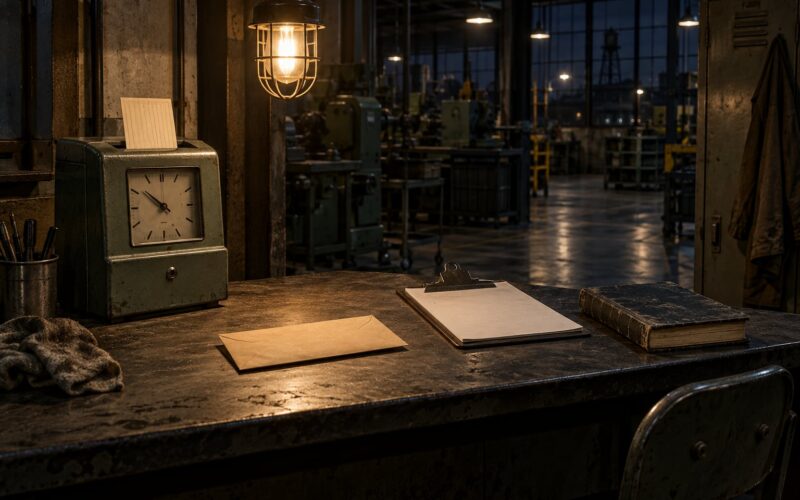
Short answer: noir is about economics because money, class position and power decide who comes out whole at the end of a noir story. Characters enter poor, greedy, or both, and they leave poorer, while the institutions holding the cash sail on untouched. The rain, the venetian blind and the fedora are the costume. The plot underneath is a balance sheet.
That is an unfashionable claim, since noir usually gets sold as an atmosphere. Shadow, alienation, a corrupt city, a woman who will not be pinned down. But atmosphere is what noir borrowed from German Expressionism in the early 1920s, and noir economics is what it built on top of it, in the United States, in the years when roughly a quarter of American workers were jobless and nobody could promise that next quarter would be better.
The word “noir” itself is French for black, and it was applied to the films later, by French critics, to a set of American pictures Hollywood had been making since the early 1940s. Raymond Chandler, who worked his way out of a Depression-era sales job into writing full time, described his own trade as an attempt to put “the real juice of the story” back into the language. The juice, in almost every one of his stories, was money someone wanted and could not have by asking.
Table of Contents
- Why Noir Is About Economics in the Genre’s Central Conflict
- What Does “Why Noir Is About Economics” Mean?
- How Do Money and Power Shape a Noir Plot?
- The Noir Money Lexicon
- Why Does Economic Desperation Produce Moral Ambiguity?
- What Role Do Work, Class, and Corporate Power Play?
- How Is Desire Connected to Noir Economics?
- Why Noir Differs From Crime Stories Centered Only on Detection?
- Does Every Noir Story Need an Economic Lesson?
- Where to Start, by Economic Decade
- Frequently Asked Questions
- Is noir always about money?
- How is noir different from hard-boiled detective fiction?
- Why does noir portray corruption so often?
- Does noir have a political or class-conscious message?
- How can writers use economics without making a story feel preachy?
- Conclusion: Begin With What the Character Stands to Lose
Why Noir Is About Economics in the Genre’s Central Conflict
Money decides who gets to make a demand in a noir story. The private investigator needs it before he will move. The widow needs it and does not have it. The executive needs it never to become a story at all, which is why he pays somebody to make sure of that. The moment a character asks for something they cannot pay for out of wages, the plot starts moving, and it moves downhill for everybody.
Look at where noir puts its camera. It sits low, in cars, in apartments rented by the month, in hotel rooms, at the end of a bar, in an office where somebody’s name is on the door but somebody else’s name is on the payroll. It rarely sits in a house that is paid off. The class position of the character telling you the story is usually one or two steps below the person he is describing, and that gap is where the crime lives.
What Does “Why Noir Is About Economics” Mean?
It means the genre takes money, work and ownership seriously enough to build plots out of them, rather than using a robbery as a reason for a murder. Read this way, noir’s real subject is the price of everything: a job, a house, a secret, a favour, a life. The subject is not only cash. It is income, debt, unemployment, property, insurance, bribery, blackmail, and who has the authority to decide any of those questions.
The distinction matters. A story in which a character wants money and gets it is a heist story. A story in which a character wants money and gets it, then loses the house, the job, the licence, the woman and the friend who covered for him, because the money was borrowed from a system that does not negotiate, is doing something else. That is noir, and the reason why noir is about economics.
How Do Money and Power Shape a Noir Plot?
The mechanism repeats. Scarce money creates pressure on somebody with no legitimate way to relieve it. That pressure makes a crime look like a solution. Once the crime happens, the money it produces becomes a handle other people can grab, and the plot turns into a fight over who controls the proceeds. Almost nobody in the chain ends up richer, which is the part that used to puzzle readers and still does.
Double Indemnity (1944) is the cleanest case. Walter Huff is a Los Angeles car dealer who wants a house he cannot qualify for, and a claims manager named Keyes offers him a legitimate outlet: policies written so that a car accident pays twice, on cheap used cars sold to people who cannot read a contract. Walter takes the bait because the motive was financial before it was criminal. He pays in installments of a different kind, and the picture’s ending has him meeting Keyes in a rail car, which is not a coincidence about where men talk business.
Notice what the film does not do. It does not suggest Keyes is a bad man who happens to employ Walter. Keyes is a professional inside a company, doing what the structure rewards. The crime is contained in the ordinary economy of the used-car lot and it will keep running whether or not Walter Huff goes to prison.
The Noir Money Lexicon
Writers reading noir notice the frequency of economics without being able to name it. The period vocabulary is the giveaway, and none of these terms is obscure once you have seen it used.
- Front money: cash paid to an author up front against future royalties. A noir character without it cannot eat while waiting for the payoff, which is the whole problem in one phrase.
- Sinew: slang for money itself, especially money that is hard to get. A cop asking a suspect where the sinew is has asked where the money is.
- Payoff: the killing that settles an account, and also the distribution of take to the people who earned it. The double meaning is the point: the debt is paid in a body.
- Racket: an operation, usually an illegal one, that produces steady income. Noir’s best rackets survive their owners.
- Fixer: someone with contacts who makes a charge go away or a witness go quiet. A fixer is a broker between the powerless and the institution.
- Sinecure: an easy post with a good cheque and no duties, usually held by somebody who owes their position to someone richer.
Why Does Economic Desperation Produce Moral Ambiguity?
Because a person who needs money has fewer honest choices than a person who does not, and noir wants the reader to watch the difference shrink. Debt removes options first. Then a low wage, a job that can vanish, a family that depends on the cheque. By the time the character considers a crime, the reader has already been shown the smaller options, and they have been shown as insufficient.
This is why noir withholds judgment so consistently. A crime story that ends with the villain in court assumes the law was the fair option all along. Noir keeps showing you the conditions that made the crime attractive and then refuses to award the protagonist the satisfaction of being convicted for the right reasons.
It also explains the endings. Noir hands you a morally ambiguous protagonist in a bleak world, and a single bad financial decision is usually the hinge. The system the character leaned on has no interest in rescuing them. Everyone ends badly because nobody in a noir story has enough standing to be forgiven.
Otto Penzler’s much-quoted line in crime-writing circles is that noir is about losers rather than private eyes. That is a psychology line, but it is also an economic one. Losers in noir lose because the scale is rigged and the loss compounds. Greed, desire and resentment accelerate it; they do not start it.
What Role Do Work, Class, and Corporate Power Play?

Work appears in noir as the thing that runs out. Nobody in these stories is upwardly mobile in any way the economy would recognise. The investigator is a contractor who gets paid per job and cannot bill for the months between them. The soldier is a veteran with a disability he does not discuss. The small businessman has a book he should not have. Even the professionals in noir novels, doctors, lawyers, accountants, tend to be the ones with a financial problem before the first page ends.
The boardroom version is where noir gets genuinely cold. In The Maltese Falcon (1941), every party to the story claims some interest in a small black bird: a widow who wants to sell it, a Greek named Gutman who wants to collect it, a lawyer serving him, an agent tracking it for a client, and Sam Spade, hired to retrieve it for a stated price. The bird is worth a great deal of money to exactly one of them. It is the most efficient portrait of ownership in the genre, because everyone treats the same object as their own property while calling themselves the legitimate party.
The Big Sleep (1946) makes the same point from the top of the ladder down. A wealthy retired general hires Marlowe with a retainer to handle material concerning his daughter, and the retainer is large enough to change Marlowe’s life. Every character in that story holds something over someone else, and the money is the reason the leverage exists.
There is a discomfort in all this worth naming. Noir’s default cast is heavily white and male, and its economics have been read as more convincing than its treatment of racial exclusion. Critics have argued that the genre stages economic power far more carefully than it stages race, which leaves a specific problem: the people most often locked out by the economies noir describes are the ones the camera moves past. If the argument is that noir is about economics, then the exclusion of Black, Latino and immigrant characters has to be part of the economics, not an unfortunate oversight around it.
How Is Desire Connected to Noir Economics?
Money in noir is never only a number. It stands for the things a low-level character cannot otherwise get: control over his own time, a room that is his, respect, safety, and the specific freedom that comes from owing nobody an explanation. Greed is the crudest version, but noir is more interested in the version where the character wants an ordinary life and the price of it has moved out of reach.
Cape Fear (1962) is built on that. Sam Bowden is a mechanic with a house and a family and a mechanic’s wages, and his value to the story is a piece of testimony from years earlier. He is terrified not of violence in the abstract but of what he can lose. A noir character never wants a car or a fur coat; he wants a thing that stands for not being at the mercy of whoever is standing behind the counter.
That is why noir villains want the woman as well as the money. The woman is portable proof of a life arrived at, and controlling her is a way of controlling the version of the world the character is trying to buy. The same logic explains why noir heroes keep lighting cigarettes for people who just bought the restaurant.
Why Noir Differs From Crime Stories Centered Only on Detection?
Detection is a way of spending plot, not a moral position. Noir, hard-boiled fiction and the mystery all use a crime to open a story, but they hand the reader something different at the end, and the difference is almost entirely economic.
| Element | Noir | Hard-boiled detective fiction | Mystery |
|---|---|---|---|
| Moral center | None, or unstable | Present, often in the investigator | Neutral, the truth is the point |
| Economic stakes | Survival and debt | A fee and a client reputation | An inheritance, a policy, a stolen object |
| Typical protagonist | Pressed from below, guilty or compromised | A professional with rules | Someone outside the situation |
| Who usually caused the crime | The victim, the client or the employer | An outside criminal | A stranger with a hidden motive |
| Typical ending | Fatal or ruined | Case solved, professional intact | Problem solved and closed |
| What the money does after the credits | Stays with the institution | Gets paid out to the detective | Is recovered by the rightful owner |
The hard-boiled investigator is, in effect, an independent contractor inside a market economy. He is hired, he charges a fee, he returns the goods or the money, and his competence is rewarded with more work. Noir removes the reward. The investigator finds that his client needed him to confirm something about a person he already suspected, and the fee turns out to have been intended as a bribe that he declined to notice.
Mystery keeps the money as the trigger, the motive being a policy or a will, but the pleasure is identification. Noir gets the same information and uses it as a mirror. The question is not who did it. It is who could afford it.
Does Every Noir Story Need an Economic Lesson?
No. Noir is full of romance, violence, psychology, guilt and identity, and a story can be noir without anyone discussing a mortgage. Setting a limit matters, though. The best examples let money or power change what a character chooses, who they trust and what happens to them next. When money is purely decoration, what you have written is a mood in a trench coat.
The machinery has not stopped running, either. Contemporary neo-noir keeps the same engine under different conditions: precarity instead of a Depression-era factory closure, gig work instead of a foreman, corporate data instead of a clipboard in a claims office. Scholarship on neoliberal noir treats the debt itself as an emotional force that shapes mood, not only a balance-sheet line. The characters are still short of money in 2026. The employer is just no longer visible from the room.
For writers, the practical version is simple. Give every character one thing they cannot afford to lose, and let the story take it. Put the stake in the language of what somebody owns, owes or is about to sign, rather than in narration about the unfairness of the world. The economics will do their own work once it is attached to a person.
Where to Start, by Economic Decade
- Double Indemnity (1944): debt, insurance fraud and a specific house price.
- The Maltese Falcon (1941): property, ownership claims and a man hired by commission.
- The Third Man (1949): postwar shortages and the black markets that grow around them.
- The Big Sleep (1946): blackmail, a wealthy retainer and the gap between two classes.
- Sunset Boulevard (1950): a studio system that no longer has a place for an ageing star.
- Cape Fear (1962): a witness who is afraid of losing his property and his name.
- Drive (2011): neo-noir version of the same pressure, with day rates and one unpayable debt.
Frequently Asked Questions
Is noir always about money?
Not literally, but money is the medium every other pressure travels through. Status, safety, loyalty and desire all get a price attached, and the question behind most noir scenes is who can afford to want something. You can write noir about love, identity or violence and still be writing about who holds the upper hand.
How is noir different from hard-boiled detective fiction?
The cleanest difference is a moral center, and money is where that center shows up. In hard-boiled fiction the investigator is hired, paid a fee, and returns the money or the stolen goods. The system is sloppy but solvent, and competence gets rewarded. Noir takes the reward away: the client is often the criminal, the fee was always a bribe, and the institution recovers its loan while the investigator carries the loss.
Why does noir portray corruption so often?
Because noir is mostly narrated from just below the people who allocate resources. Officials, executives, doctors and bankers keep appearing because they are gatekeepers a low-level protagonist needs, and gatekeeping invites extortion. Otto Penzler’s line that noir is about losers rather than private eyes fits here: corruption is what a losing side does to a system that will not negotiate with it.
Does noir have a political or class-conscious message?
Often, though it rarely states a slogan. Class positions are legible in the fiction: hired help in a fedora, a shopkeeper with a bad book, an executive nobody can telephone. Critics have argued that noir’s default cast is uncomfortably white and male, which leaves a gap. Read that way, noir is less a solution than a pressure gauge.
How can writers use economics without making a story feel preachy?
Give the money a job in the scene instead of a lesson in the narration. Put a character in front of two bills, one shift and one confession. State the stake in terms of what somebody owns, owes and can lose, then stop talking about it. Preachiness arrives when the narration explains a system while the character stands still.
Conclusion: Begin With What the Character Stands to Lose
Noir is about economics because the genre treats money, work and ownership as the actual forces deciding who survives, and it refuses to pretend the ending will be fair to everyone. The criminal plots, the downward spirals and the fatal last pages all come from the same place: characters who entered without enough standing to absorb a loss.
So start there, whether you are reading or writing. Ask what the character is about to lose, who holds the thing they need, and whether that person has any reason to be reasonable. Those three questions do more noir work than any amount of rain on a fire escape.